Partition and the birth of Northern Ireland
|
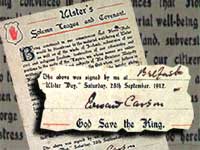
In the seventy years leading up to partition in May 1921, industrialization had taken root in the predominantly Protestant north-eastern counties of Ulster. Southern Ireland which was overwhelmingly Catholic remained an agrarian economy. Towards the end of the 19th century Gladstone's Liberal government responded to demands from nationalists throughout Ireland for Home Rule. Unionists believed Catholicism was an oppressive, backward religion and feared that Home Rule would result in Rome Rule. Moreover, they believed a parliament in Dublin run by what they regarded as 'primitive' Catholic farmers would be bad for Protestant business. By 1886 they began to lobby for the preservation of the union which they felt was in danger; it was not until 1912-14 that they pressed for partition accepting that Home Rule was inevitable. Gladstone had little luck with his Home Rule Bills. His 1886 Bill was lost in the Commons because of a Liberal Party revolt and the 1893 Bill was defeated in the Lords. Asquith's Liberal government introduced the third Home Rule Bill in 1912. Dublin Unionist MP Edward Carson threatened armed resistance if Ulster was governed from Dublin. Between 1912 and 1914 Unionists signed the Solemn League and Covenant and formed the UVF, an armed Protestant militia to fight against Home Rule. The specter of civil war hung over Ireland over the Ulster issue. The Bill was passed in parliament but suspended for the duration of the Great War.
The possibility of Home Rule stemmed the campaign for an independent Ireland but the 1916 Easter Rising changed this. The execution of its leaders inflamed nationalist opinion and by 1918 Home Rule was no longer acceptable to most nationalist opinion. In the General Elections of that year the pro-independence Sinn Féin won virtually every seat outside of Ulster. The following year the Irish Republican Army began a guerrilla war against Britain. In 1920 the British parliament passed the Government of Ireland Act which attempted to set up a home rule parliament/government in both north and south. The aim was to keep both jurisdictions under Westminster control and hopefully satisfy and reconcile legitimate unionist and nationalist aspirations; honor promises made to both by British ministers and to get rid of the Irish question from Westminster politics. Ulster unionists accepted the deal while Irish nationalists rejected it and continued their war of independence until a treaty in 1921 created a 26-county Irish Free State which gave it dominion status like Canada. The new state of Northern Ireland contained a built-in Protestant majority. Premier Craig chose to consolidate unionist power rather than attempt to broaden the appeal of his government and party. His government was arguably under siege but he adopted policies which entrenched this position by changing the electoral system from PR to First Past the Post. He also altered local government boundaries to the advantage of unionism enabling his party to control the nationalist city of Londonderry. Unionist discrimination against Catholics in housing and employment help explain why Northern Ireland's one party state collapsed in violence 50 years later. Top of Page Northern Ireland Civil Rights' Movement
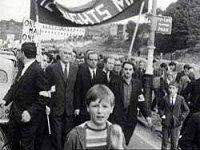
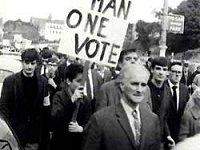
The Northern Ireland Civil Rights Association was formed in January 1967 as a response to four decades of Unionist discrimination against Catholics. It had five demands: one man, one vote in council elections; ending of gerrymandering of electoral boundaries; machinery to prevent discrimination by public authorities and to deal with complaints; fair allocation of public housing; repeal of Special Powers Act and disbanding of B Specials, a predominantly Protestant auxiliary police force. The civil rights movement was born in the O'Neill era, the period from 1963-69 when Captain Terence O'Neill was Prime Minister of Northern Ireland. Only the fourth Prime Minister in more than 40 years of Unionist rule, his rhetoric of reconciliation between Catholics and Protestants was a departure from his predecessors Craig and Brooke who had long promoted the concept of Stormont as a Protestant government for a Protestant people. O'Neill made history when he invited the Irish Taoiseach Sean Lemass to Stormont in 1965. He angered fundamentalist Protestants when he became the first Prime Minister to visit a Catholic convent school and shake hands with a nun. These public demonstrations of reconciliation did not deliver what Catholics wanted which was civil rights and equal participation in Northern Ireland. A new generation of Catholics who had benefited from the 1949 Education Act had greater expectations. They watched how the civil rights movement in America and the student movement in France had mobilized to achieve change and concluded that direct action in Northern Ireland was their only alternative.
The civil rights campaign politically mobilized Catholics for the first time since the formation of the Northern Ireland state in 1921. Unionists had gerrymandered the electoral boundaries in Londonderry to safeguard power for unionists. This power was confronted for the first time on 5 October 1968 when NICRA staged its second civil rights march there. The march had been banned by the Minister for Home Affairs William Craig who accused the civil rights movement of being a political front for the IRA. The presence of a single camera crew from RTE, the Irish national television station, caught graphic pictures of police brutality as the RUC beat the marchers, including a number of prominent politicians, off the street. The pictures broadcast around the world reminded people of the tactics used by police against the black civil rights movement in America's southern states. The Catholic community's confidence in the RUC was further eroded and this seriously undermined the Unionist state. More civil rights marches were organized. Protestants viewed these events with concern and feared Catholics were engaged in a conspiracy to undermine their political hegemony. Paisley exploited these fears and mounted counter-demonstrations which provoked riots between civil rights marchers and Protestants. Top of Page Battle of the Bogside
By the summer of 1969 the crisis in Northern Ireland had deepened considerably. Terence O'Neill who had sought to open dialogue with Catholics had resigned and been replaced by Major James Chichester-Clark. Unionists, who had ruled Northern Ireland as a one party state since 1921, had no experience of negotiating with the minority Catholic community. Catholic demands for civil rights had not been satisfied and as the loyalist marching season approached sectarian passions were inflamed. The Orange marching calendar has two big annual events. On 12 July Orangemen commemorate the Battle of the Boyne in 1690 when the Protestant King William defeated the Catholic King James. The other big event is 12 August when Apprentice Boys march in Londonderry to commemorate the Siege of Derry in 1689 when local apprentice boys closed the city's gates against King James' army.
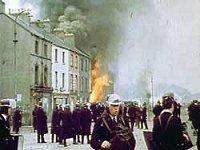
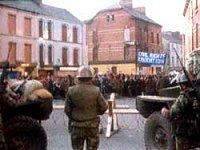
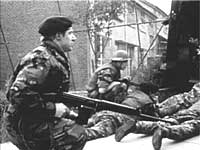
Tensions between Derry Catholics and the RUC were high in the summer of 1969. The previous month Sammy Devenney had died from injuries he received when RUC officers battered him in his own home. As the 12 August approached there was an expectation that the march would trigger unprecedented violence. Sectarian clashes occurred as the Apprentice Boys marched past the perimeter of the Catholic Bogside. The RUC intervened and, assisted by a Protestant mob, charged at the nationalists forcing them into William Street. Within hours rioting had escalated into what local priest Fr Mulvey described as a "community in revolt". The police were stoned and petrol bombed as they made their way in riot gear into the Bogside. After two days and nights of continuous rioting the police were exhausted. On the afternoon of Thursday 14 August the new Prime Minister of Northern Ireland, James Chichester-Clarke, called the British Prime Minister Harold Wilson and asked for troops to be sent to Derry. Unknown to Chichester-Clark troops were already on standby. Just after 4:00 pm a company of soldiers from the Prince of Wales Own Regiment relieved the police of their duty. What came to be known as the Battle of the Bogside had ended with direct intervention from Britain in the affairs of Northern Ireland. Riots erupted in Belfast after the Civil Rights Association called on Catholics to take pressure off the Bogside by stretching police resources. Five Catholics and one Protestant were killed on 14 August. The following day troops were deployed in Belfast to contain the violence but too few in number to have any effect. That night a Protestant mob burnt almost every Catholic house in Bombay Street. Lieutenant-General Sir Ian Freeland told the press at the time that the honeymoon period between troops and local people was likely to be short-lived. Within months that welcome had turned to violence. Top of Page Provisional IRA emerge
Between 1956 and 1962 the IRA mounted an unsuccessful border campaign. Internment without trial, introduced first in the north and then in the south, curtailed military operations and ultimately broke morale. On 26 February 1962, the IRA announced that Operation Harvest, its border campaign, was over. Under new leadership, the IRA became influenced by the optimism of the 1960s. The cold war between the Unionist parliament at Stormont and the Fianna Fáil government in the Republic began to thaw. Taoiseach Sean Lemass, a former IRA man who had fought in the 1916 Easter Rising and opposed partition, accepted an invitation from the Prime Minister of Northern Ireland, Terence O'Neill, to visit Stormont. O'Neill reciprocated with a visit to Dublin. Influenced by the mood of the times, the IRA embraced a Marxist agenda and gave up violence as a means of achieving a united Ireland. Its new policy was a 32-county socialist republic. Influenced by the writings of Wolfe Tone, its strategy was to unite Catholic, Protestant and Dissenter in Northern Ireland so that they would eventually join workers in the south to overthrow capitalism. Their idealistic theory left two important factors out of the equation: Rev Ian Paisley and other diehard unionists opposed to O'Neill's liberal policies had begun to plot his downfall; and working class Catholics whose lives had been blighted by discrimination were fervently anti-communist. While the IRA chose politics, militant loyalists revamped the Ulster Volunteer Force in 1966 and embarked on a sectarian campaign against Catholics.
In 1967 the Northern Ireland Civil Rights Association (NICRA) was set up and organized street demonstrations to lobby for civil rights. The Stormont government branded the movement a front for the IRA and banned its marches. In October 1968 the RUC used heavy-handed tactics to disperse a Civil Rights Association march in Londonderry and in January 1969 a People's Democracy march was attacked. Tensions between Catholics and Protestants deepened and by August 1969 Catholics were being burned out of their homes and shot on the streets of Belfast. At an IRA convention in December 1969 the Belfast Brigade argued that the IRA had lost credibility because it failed to protect Catholics from sectarian attacks. They favored a return to an armed strategy. But the convention voted in favor of politics and the Northern Brigade walked out and set up the Provisional Army Council. The formal split came at the Sinn Féin Árd-Fheis in January 1970 when those opposed to recognizing the parliaments in Dublin, London and Belfast walked out and set up Provisional Sinn Féin. The Provisional IRA established in December now had a political wing. In 1994 they were to call a cease-fire to allow politics to work. Top of Page Internment
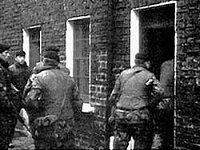
At dawn on Monday 9 August 1971, 3,000 soldiers backed up by RUC Special Branch officers using out-of-date intelligence swooped on houses throughout Northern Ireland and arrested over 300 men. By the time the operation was complete three hours later the army had arrested many who belonged to neither the Provisional nor Official IRA. Within 48 hours 104 were released. The remainder were imprisoned at Crumlin Road Jail or on the Maidstone, a prison ship moored at Belfast docks. As the arrests continued the army had to open a disused RAF base called Long Kesh to accommodate the prisoners. Brian Faulkner, Northern Ireland's third Prime Minister in little over a year, introduced internment without trial to counteract IRA violence but his strategy backfired. The security measure was used almost exclusively against the Catholic community and within hours rioting and shooting had broken out in Belfast and spread to Derry, Strabane, Armagh and Newry. At 11:15am that morning Faulkner announced that his government was at war with the terrorists. The Unionist government had previously used internment successfully against the IRA during its 1950s border campaign but in 1971 it proved a serious security and political blunder. Up until 9 August, 34 people had died in the violence that year but just three days later 22 more people had been killed. Thousands of people had been forced to leave their homes in Belfast because of sectarian attacks and many left for refugee camps across the border. Writing years later, the Home Secretary Reginald Maudling who sanctioned the action said the experience from 1971 to 1975 "was by almost universal consent an unmitigated disaster which has left an indelible mark on the history of Northern Ireland". Internment flouted international human rights standards. Many of those arrested were subjected to inhuman and degrading treatment. The army, determined to get up-to-date intelligence, resorted to interrogation methods previously used in the former British colonies. Detainees thought likely to have important information were physically weakened through sleep deprivation and a bread and water diet. They were then spread-eagled for hours against a wall with hoods over their heads and subjected to disorientating electronic white noise. Civil rights lawyers accused the government of torture. The Irish government made a formal complaint to the European Commission for Human Rights and later the European Court of Human Rights. The Commission found Britain guilty of torture and the European Court ruled that the treatment was inhuman and degrading but did not constitute torture. Internment not only provoked more violence but it galvanized support for the IRA and enabled republicans to raise money in the United States. It led to hundreds of street demonstrations one of which culminated in Bloody Sunday. Top of Page Bloody Sunday
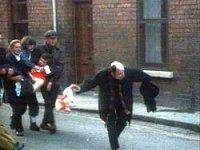
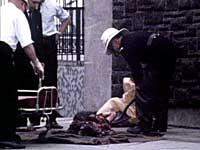
Bloody Sunday is named after the events that occurred on Sunday 30 January 1972 when British soldiers shot dead 13 men and injured 14 others. A further victim died later. The killings took place in the predominantly nationalist city of Londonderry. The victims had been taking part in an illegal march against internment without trial. It had been organized by the Northern Ireland Civil Rights Association (NICRA) and was both a protest against internment and a protest against the ban on the right to march. Anxious that the 30 January march should pass off peacefully, the organizers had sought and received assurances from the IRA that it would withdraw from the area during the march. On the day of the march some 10,000 people had gathered in Creggan Estate and proceeded towards Guildhall Square in the center of the city. Paratroopers had sealed off the approaches to the square, and the march organizers, in order to avoid trouble, led most of the demonstrators towards Free Derry Corner in the Bogside.
Groups of local youths stayed behind at the army barricades to confront the soldiers. Their orders were to move in and arrest as many of the rioters as possible. At 4:07pm a paratrooper requested permission to arrest rioters. At 4:10pm soldiers opened fire on the crowd. Less than 30 minutes later 13 civilians were dead. The soldiers claimed that they had been fired on as they moved in to make arrests. The people of the Bogside believed the army had summarily executed 13 unarmed civilians. The killings provoked outrage and were denounced as "another Sharpeville". The British Embassy in Dublin was burned down and Bernadette Devlin MP physically attacked the Home Secretary Reginald Maudling in the House of Commons. The Prime Minister Edward Heath appointed the Lord Chief Justice of England, Lord Widgery, to conduct an inquiry. Widgery's verdict was controversial when it appeared in April 1972. He concluded that the soldiers had been fired on first yet there was no evidence that the dead or wounded had been shot while handling weapons. The Londonderry Coroner, Major Hubert O'Neill, did not share his conclusions. He said what had occurred was "sheer unadulterated murder". On the twentieth anniversary of the killings there were calls for an independent inquiry. The Prime Minister John Major's response that those killed could be regarded as innocent did not satisfy the relatives of the dead and injured. On 30 January 1998 Prime Minister Tony Blair announced that there would be a new inquiry on the grounds of "compelling new evidence". Lord Saville of Newdigate was appointed to chair the inquiry and its findings are not expected to be published for some time yet. Top of Page Direct Rule
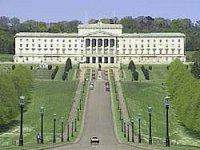
The Unionist parliament at Stormont, which had governed Northern Ireland since the foundation of the State in 1921, sat for the last time on Tuesday 28 March 1972. Conservative Prime Minster Edward Heath had decided to strip the parliament of its power and introduce direct rule from Westminster. He was responding to the worsening security situation that was aggravated when paratroopers, deployed by the Stormont government, shot dead 13 unarmed civilians during a civil rights march in Derry. Two days later an angry crowd burned down the British Embassy in Dublin and in February an IRA bomb at the Aldershot HQ of the Parachute Regiment killed three civilians. This was followed by an assassination attempt on a Northern Ireland government minister. Bloody Sunday provided a recruitment boost for the IRA who stepped up their bombing campaign. By March the newly formed Ulster Vanguard Movement assembled 60,000 supporters at a rally in Belfast and heard their leader, William Craig, state that if the politicians failed to deal with the IRA "it may be our job to liquidate the enemy". With the situation worsening by the day Edward Heath called Brian Faulkner, the Northern Ireland Prime Minster, to Downing Street and insisted that control of law and order be transferred to the Westminster government. Neither Faulkner nor his cabinet were prepared to do this so he and his ministers resigned.
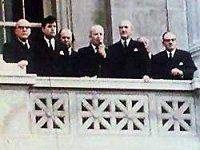
On the day the parliament met for the last time, 100,000 unionists converged on the drive before Stormont. This was the second day of a protest strike called by the Vanguard leader William Craig against British government policy. The strike affected power supplies, forced businesses to close and stopped public transport. When Faulkner and Craig joined other leading unionists on the balcony at Parliament Buildings they were greeted with cheers. Many were expecting Craig to announce a Vanguard coup but this did not materialize. Faulkner called for restrained and dignified protest and then asked the crowd to disperse. The two-day strike was at an end. All political power in Northern Ireland now rested with William Whitelaw the newly appointed Secretary of State and a new government department, the Northern Ireland Office, was set up to manage day-to-day affairs. Catholics welcomed the fall of Stormont but the IRA saw direct rule as further evidence of British intent to remain in Northern Ireland and they stepped up their bombing campaign. Apart from the five months of the power-sharing Executive in 1974, Northern Ireland was governed from Westminster until 2 December 1999 when the Northern Ireland Executive set up under the Belfast Agreement took over responsibility of government. Difficulties over decommissioning forced the government to impose direct rule again between February and May 2000. Top of Page Cease-fire and Bloody Friday
Attempts to persuade the IRA to call a cease-fire intensified after the Abercorn Bar bomb on 4 March 1972. The following day Independent Unionist MP Tom Caldwell met IRA leaders in Dublin. They suggested negotiations with London and to demonstrate good intention called a three-day cease-fire to begin on 10 March. On the last day of the cease-fire the opposition Labor leader Harold Wilson and his Northern Ireland spokesman Merlyn Rees flew to Dublin. The meeting took place at a house in the Phoenix Park but it achieved nothing. On 24 March the government introduced direct rule from Westminster. The IRA intensified its military campaign. At the end of May, following disastrous publicity around the death of a Catholic soldier in Derry and their Bloody Sunday revenge bomb at Aldershot in February that killed civilians rather than soldiers, the Official IRA declared a permanent cease-fire. The Provisional IRA, sensing the nationalist community had had enough and believing they were in a strong negotiating position, called a press conference in Derry and announced they were prepared to call a truce. But in exchange for a cease-fire and talks they wanted the government to grant prisoner of war status. The Government agreed and Whitelaw introduced special category status on 20 June. The IRA reciprocated with a cease-fire six days later.
IRA leaders, including Martin McGuinness and Gerry Adams, were flown to London on 7 July and met Secretary of State William Whitelaw at a house in Chelsea. There the IRA demanded that Britain withdraw from Ireland before 1 January 1975. Whitelaw could not agree and the talks broke down. The cease-fire ended two days later on Sunday 9 July when the IRA opened fire on soldiers who had been preventing displaced Catholics moving into empty houses vacated by Protestants at Lenadoon Avenue in west Belfast. That night nine people died including a Catholic priest. The killings and bombings continued and on Friday 21 July nine people died when, in little over an hour, 21 bombs exploded one after the other in Belfast. This day became known as Bloody Friday. Nine deaths were caused by two of the 21 bombs. Six people died at Belfast's busiest bus station. Another bomb outside shops on the Cavehill Road killed two woman and a 14-year-old boy. A police officer interviewed by the BBC said: "You could hear people screaming and crying and moaning. One of the most horrendous memories for me was seeing a head stuck to a wall. A couple of days later we found vertebrae and a ribcage on the roof of a nearby building." The IRA blamed the
security forces for not passing on the warnings in time. Sunningdale Agreement The sectarian strife continued throughout the 1980s, punctuated by high drama, terrorism and moments of possible political compromise. Bringing the IRA fight into the international spotlight was Bobby Sands, an IRA member who died while on a hunger strike in a Belfast prison to protest his status as a common prisoner, rather than a political one. His passing and the death of nine fellow IRA inmates in 1981 sparked more outrage and riots, and brought increased sympathy for the IRA's drive for a united Ireland. Anglo-Irish Agreement and the Guildford Four The decade ended with the dramatic release of four men
jailed for the 1975 Guildford pub bombings, after revelations that concluded
police had lied and fabricated confessions. By 1989, some 2,700 people had
died in the 20 years of fighting – about 1,900 were civilians. The 'Downing Street Declaration' and IRA Cease-Fire The goodwill toward Sinn Fein spilled into 1994 when the United States granted a visa to its long-outlawed leader, Gerry Adams. The IRA responded later that year with a declaration of its own, announcing a "complete cessation of military operations" in August. The announcement opened the way for talks that year between Sinn Fein and British civil servants, the first in 22 years. Top of Page Mitchell Principles and Good Friday Agreement Movement on Mitchell's six principles of non-violence for entry into all-party talks progressed into 1997 as the IRA renewed its cease-fire in July. In September, both Sinn Fein and the Ulster Unionists agreed to the Mitchell principles and entered the all-party talks. Northern Ireland issue with Ireland (historic peace agreement signed 10 April 1998) Finally, after 21 months of talks, Northern Ireland's political leaders reached a historic Good Friday (10 April 1998) agreement on a new form of self-rule for the embattled province, giving minority Catholics a greater voice while meeting Protestant demands that the province remain a part of Britain. The plan was approved resoundingly by voters in the North and the Irish Republic in May 1998. Voters cast ballots in June for the new Northern Ireland Assembly. Backers of the Good Friday agreement earned a controlling majority in the governing body. Progress on the political front, however, did not stop the violence. In August, terrorists detonated a car bomb amid a throng of shoppers in the town square of Omagh, killing 28 people. It was the single worst terrorist incident since the beginning of the Troubles in the late 1960s. A splinter group of the mostly Catholic Irish Republican Army, known as the "Real IRA," claimed responsibility for the attack. The bombing was a huge setback for many backers of the peace agreement, who had hoped the 30-year-old struggle – which has taken the lives of more than 3,400 people – was coming to an end. By 1999, Protestant and Catholic negotiators had turned their efforts to another serious menace to the peace accord: a decision on how and when to dispose of paramilitary arms and munitions held by the two sides. Days of intensive negotiations followed in the spring and summer of 1999, but no agreement was reached. The transfer of power from London to Northern Ireland came only at the end of 1999 and was rescinded in February 2000. |