Culture of Wales
Patron Saint
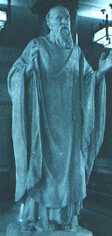
Dewi Sant/St David - a Saint of the Celtic Church - son of Sandde, Prince of Powys, and Non, daughter of a Chieftain of Menevia whose lands included the peninsula on which the little cathedral town of St Davids now stands.David became the Abbot of Ty Ddewi/St Davids and died on 1st March 589 AD. He was buried in what is today St Davids Cathedral in Pembrokeshire. So respected was he that medieval pilgrims believed that two pilgrimages to St Davids were worth one pilgrimage to Rome! Fifty churches in South Wales alone bear his name. March 1st, St David's Day, is now the traditional day of the Welsh - celebrated by Welsh people all over the world, wearing either of the national emblems - a leek or a daffodil. Usually the day's celebrations will include either a Noson Lawen (Folk Evening), an eisteddfod or a dinner with a guest speaker.
National Flag
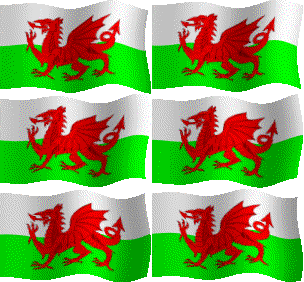
A red dragon passant on a green and white field. No-one really knows how the red dragon became the emblem of Wales. However, it seems that the early Britons probably used it as a battle standard, after the Roman occupation and that it may derive from a Roman Standard. One clue to this theory is that the English word "Dragon" and the Welsh word "Draig" both come from the same latin root "draco".In any case the dragon has become a symbol identified with Wales. A legend recorded by an 8th century historian tells of a fight between a red and a white dragon, which ends with the eventual triumph of the red dragon - representing Wales. In 1959, the Queen commanded that Red Dragon on a green and white field be flown as the official Welsh flag.
National Emblems
The Leek
There are many legends telling us how the leek came to be the national emblem of Wales. A popular one is that St David advised the Britons on the eve of a battle with the Saxons, to wear leeks in their caps so as to easily distinguish friend from foe. This helped to secure a great victory. It is also thought that the same thing occurred when Welsh archers fought with Henry V at the battle of Agincourt. Hence, the wearing of leeks on St David's Day. It is still a surviving tradition that soldiers in the Welsh regiments eat a raw leek on St David's Day.The Daffodil
The Harp
Possibly one of the reasons why the daffodil is used as an emblem is that the word for daffodil and for leek are similar in Welsh (Cenhinen = Leek, Cenhinen Pedr = Daffodil). This confusion means that both have been adopted as national emblems.
The harp is regarded as the national instrument of Wales. Although it enjoyed a special status in Wales for a thousand years or more, no native harp from earlier than 1700 survives today. Some manuscript sources provide information about the harp and its music around the medieval period in Wales.By the end of the 18th century, the triple harp - so called because it had three rows of strings - was widely known as the Welsh harp on account of its popularity in Wales. Although generally thought to have been invented in Wales it was, in fact, one of the baroque instruments devised in Italy about 100 years earlier. The harp has been used through the ages as an accompaniment to folk-singing and dancing and as a solo instrument.
The Three Feathers
The Crest of three ostrich plumes and the motto "Ich Dien" were adopted byEdward the Black Prince at the Battle of Crecy. They belonged to the House of Hainault, of which his mother, Queen Philippa, was a member. Edward III became Prince of Wales in 1343, and was a popular leader - so much so that thousands of Welshmen joined him to fight in the French wars.
In fact, a quarter of Edward's troops were composed of Welsh archers and spearmen. The feathers were then adopted by the honorable Society of Cymmrodorion in 1751, and they still adorn the badge of the National Rugby Union team of Wales.
Lovespoons
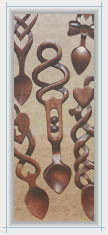
A lovespoon is a wooden spoon carved by a young man and presented to his sweetheart as a token of his affection. The earliest surviving specimen is dated 1667 but the custom was widespread in Wales before that date. The spoon may be plain or intricately decorated with various symbols - birds, hearts, wheels, balls - each representing different meanings of good luck, the blessing of children, wealth, health, etc.Nowadays, lovespoons are not given so often as a token of affection, but are a popular souvenir of Wales. More Lovespoons
The Welsh Language
Welsh is a Celtic language, related to Breton, Irish and Scots Gaelic. Its roots are lost in time, but it is regarded by some scholars to be Europe's oldest living language. Welsh and English enjoy equal validity in Wales and approximately one quarter of the population speaks Welsh fluently. In many parts of Wales at least seven out of ten people are Welsh speaking, and use Welsh as their first language at home and at work. Visitors will hear Welsh spoken as an every day language.Children in Wales may receive infant, primary and secondary education through the medium of Welsh, and, in some instances, students may receive a college education in Welsh. Spoken Welsh varies in dialect in different parts of the country. Written Welsh is standard. Since 1982, there has been a Welsh language television channel, S4C.
There is a growing interest in learning the language. Adult courses are widely available. There are also several centres specialising in residential courses, welcoming overseas as well as UK students.
Click to hear a sound sample welcoming you to Wales.
The National Anthem
The National Anthem is the result of co-operation between father and son. It is said that a weaver from Pontypridd in the South Wales Valleys, Evan James, wrote the words one Sunday morning in January 1856 to a tune composed by his son James James, which was possibly based on an old harp melody.The date of the song's adoption as the National Anthem is uncertain, but it is known that the tune was given prominence during the National Eisteddfod held at Bangor in 1874, and since that date has been considered the song which, more than any other, expresses Welsh national sentiment.
Now afforded official status as the National Anthem of Wales by general assent, Hen Wlad fy Nhadau is sung on a wide variety of occasions throughout the country.
Hen Wlad fy Nhadau Mae hen wlad fy nhadau yn annwyl i mi Gwlad beirdd a chantorion enwogion o fri Ei gwrol ryfelwyr, gwlad garwyr tra mad Tros ryddid collasant eu gwaed. Gwlad, Gwlad Pleidiol wyf i'm gwlad Tra môr yn fur i'r bur hoff bau O bydded i'r hen iaith barhau
Translation: The land of my fathers is dear to me, A land of poets and minstrels, famed men. Her brave warriors, patriots much blessed, It was for freedom that they lost their blood. Homeland! I am devoted to my country; So long as the sea is a wall to this fair beautiful land, May the ancient language remain.
Two choices, the abridged or the full version. Hen Wlad fy Nhadau sung by Morriston Orpheus Choir and The Bedwas, Trethomas and Machen Band.
Longest Placename in Wales
Most people have heard of a little town in North Wales which boasts what must be the longest place name in Britain.It is: Llanfairpwllgwyngyllgogerychwyrndrobwllllantisiliogogogoch which means "St Mary's (Church) by the white aspen over the whirlpool, and St Tysilio's (Church) by the red cave."
Click to hear how you pronounce it.
National Costume
Welsh National costume evolved in Wales in the late 18th century as a development of costume worn in town and country. The typical female costume, as designed and made popular by Lady Llanover, was made up of the following:
Tall hat, made out of hard board with thin beaver fabric glued on to it, white cap, worn under the hat, made of cotton or muslin with long frilled lappets extending down the shoulders, bedgown, petticoat, small shawl, cloak, apron. The garments are made of Welsh flannel. The costume is usually worn by young girls throughout Wales on St David's Day.
Eisteddfod
The Royal National Eisteddfod is an eight day cultural festival which takes place alternately in North and South Wales. It is held at the beginning of August every year. It attracts over 150,000 visitors and some 6000 competitors. It is the largest popular festival of competitive music-making and poetry-writing in Europe.What distinguishes the Royal National Eisteddfod from any other festival is that it takes place solely in the Welsh language. Excellent simultaneous translation facilities are available for non Welsh speaking visitors.
A modern festival by today's standards, the Eisteddfod's roots are firmly planted in over eight hundred years of tradition. The Eisteddfod (meaning "sitting together" or "gathering") evolved from ancient bardic tournaments in which apprentice poets and musicians would compete against each other for a seat of honor in the households of noblemen. Winning such a tournament was akin to securing a contract of employment, for poets depended on the patronage of wealthy noblemen and landowners for their livelihood.
These tournaments were in existence as long ago as the 10th century, when Hywel Dda, a Welsh King, is reputed to have awarded a seat of honor to a poet in his household during a competitive meeting at his court. A 12th century manuscript refers to a similar gathering at Lord Rhys ap Gruffudd's castle in Cardigan in 1176, which included poets and musicians from all over Wales.
The Caerwys Eisteddfod of 1523 was an important milestone in the Eisteddfod's development as it regulated the patronage system and graded poets and musicians according to rank and status. At the beginning of the 19th century, an Eisteddfod of historic significance was held at the Ivy Bush Inn in Carmarthen. By this time, the Eisteddfod was no longer confined to poetry but had developed into a fully fledged folk festival on a much larger scale.
The first National Eisteddfod as we recognize it today was held at Aberdare in 1861. In 1880 the National Eisteddfod Association was formed and charged with the responsibility of staging an annual festival to be held in North and South Wales alternately, and with the exception of 1914 and 1940, this target has been successfully achieved.
Over the years, the Royal National Eisteddfod of Wales has developed into a multi-faceted festival worthy of note, and a unique celebration of Welsh language, art, culture and heritage.
Wales has other Eisteddfodau, including the Urdd National Eisteddfod (for the youth of Wales) and the International Musical Eisteddfod - which is held each July in the town of Llangollen. The first International Musical Eisteddfod was held in 1947, with the aim of promoting peace between nations after the war-torn years of 1939-45, through the international language of music. This week-long Eisteddfod attracts 2,500 competitors from over 40 countries. In addition to the daily music, singing and dancing competitions, gala concerts are performed in the evenings.
Welsh Gold
Welsh gold, both rare and beautiful, has been highly valued since ancient times. Gold torcs were worn by early Welsh princes as a badge of rank and the tradition is echoed today with this gold being used to make the wedding rings of a number of Royal brides, including Her Majesty the Queen, Princess Margaret, Princess Anne the Princess Royal and the late Diana, Princess of Wales. Welsh gold, which is mined by hand, lies in a band stretching from Barmouth, past Dolgellau and up towards Ffestiniog.Unlike South African gold, which is mixed in with sand and yields just a quarter of an ounce for every ton blasted, pure Welsh gold forms in seams, like coal, which have been known to yield up to 30 ounces per ton.
There are two gold mines of note in Wales. Dolaucothi, near Pumpsaint, West Wales, owned and run by the National Trust, is the only place in Britain where the Romans are definitely known to have mined gold.
After the Romans departure, the mine lay dormant for centuries. Revival in the 19th century did not last long, with the mines finally closing in 1938. Dolaucothi's fascinating story is today told on the "Miners Way" self guide surface trail and also on exciting guided underground tours.
Clogau Gold Mine in Bontddu, near Barmouth, Gwynedd is a working gold mine which is not open to the public.