|
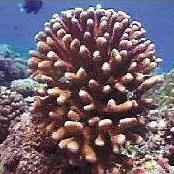
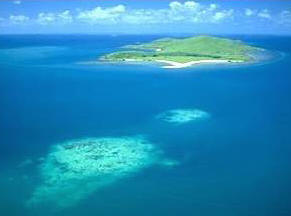
1. What is a coral? Early biologists used to think that corals were plants. In fact they are animals and are related to sea anemones, jellyfish and hydroids. All have been classified within the phyerata, since they have the same basic body design -- that is, they are symmetrical about a central axis (termed radially symmetrical). Basically each has a sac-like body which has a central cavity or stomach. There is a single opening to this cavity which serves as both a mouth and anus. This is often surrounded by a circle of tentacles (often more than one) which contain stinging cells (nematocysts). Members of the coelenterate phylum may occur in a bell-shaped form (termed a medusa) which floats or swims in the water (e.g. jellyfish) or they may occur as polyps which are attached to hard surfaces in the ocean (e.g. corals). Some occur only as polyps (e.g. corals) whilst others occur only as medusae (e.g. jellyfish). Others may occur in both forms during their life cycle (e.g. hydroids). Corals may consist of only one polyp (solitary) or they may comprise many hundreds of polyps (colonial), all joined together in the one structure (termed a colony). There are several different types of corals. Those that possess 8 tentacles (or multiples thereof) and produce an almost jelly-like body are called soft corals. Those that usually have a plant-like growth and a horny skeleton which runs along the inside of the stem (making it very strong) are called gorgonians. They are more commonly referred to as sea-whips and sea-fans. Finally there are the true stony corals which are the main building blocks of reefs. Their hard calcareous skeletons are produced by the polyps themselves. Each polyp in a colony is suspended inside a tiny cup of skeleton and is connected by a thin layer of tissue which overlies the surface of the colony. Small single-celled algae called zooxanthellae are of great benefit to corals. They live inside the tissues of most corals and produce nutrients (organic carbon) which are sources of food for the corals. As these nutrients are produced via photosynthesis the corals are able to build their skeletons much faster in the light than in the dark. Corals also possess chemical compounds which prevent them from being affected by ultraviolet radiation when exposed at low tide or d u ring prolonged periods in very shallow water. These compounds are being investigated at the Australian Institute of Marine Science because they may prove very effective as ultraviolet blocking agents in various substances (such as sunburn creams, paints and plastics). Corals reproduce in several different ways. Some bud or split from the original polyp (a form of asexual reproduction). Sexual reproduction also occurs. In some corals the eggs are fertilized internally. These are then brooded within the body of the parent and at the appropriate time are released as planulae. Other species shed their eggs and sperm into the water column and consequently fertilization occurs externally (i.e. outside the parent). This strategy is very "hit and miss" given the large volume of the oceans. To ensure that sufficient fertilization takes place many corals on the Great Barrier Reef spawn together on one night of the year. This occurs about 5 days after the full moon in late Spring (October / November). It is a spectacular event! Whilst corals occur throughout the world they are most abundant in the tropics where water temperatures are highest. Corals feed primarily during the night by expanding their tentacles and capturing minute plankton from the water. They also occur in a variety of forms, the most common being branching (sometimes called staghorn corals) and plate-like (table corals) colonies. 2. What is a coral reef? Surprisingly, the mammoth reef systems which occur in many parts of the world result from the combined activities of the small, humble coral polyp. Reefs are made up of layers of coral skeletons cemented together by coralline (encrusting) algae to form an extremely hard limestone structure. The world's largest reef system, the Great Barrier Reef, has developed in this manner. It is not one reef but a complex of almost 2,900 individual reefs stretching for a distance of about 2,300 kilometers. These individual reefs have resulted from the growth of hard corals on eroded formations (e.g. valleys, hills and ridges) which millions of years ago were out of the water when sea-level was much lower. The Great Barrier Reef comprises many different types' of reef formations. Those that have developed around continental islands (e.g. those in the Whitsunday Islands) are termed fringing reefs. Those that form long thin formations along the outside edge of the northern part of the Great Barrier Reef (much like a string of sausages) are termed barrier reefs. These can be up to 30 kilometers long and are divided by narrow passages. There are also a variety of other formations including lagoonal, crescentic and planar reefs. The formation of these different reef types depends largely on the surface on which they are being formed, the recent geological history of the area (i.e. changes in sea level and land formations), and water temperature and exposure to wave action. It has little to do with the types of corals that were important in their formation. Some reefs (e.g. Heron Island off Gladstone and Green Island off Cairns) have sandy islands on them. The combined action of waves and water currents causes the deposition of finely eroded coral material which over many years may lead to the development of these islands. Most reefs have a solid front which receives much of the force of the ocean swell. This is called the windward side of the reef. It forms a wall which slopes (sometimes quite steeply) to the bottom of the seabed (generally 40-50 m in the Great Barrier Reef). The top of this structure, termed the reef flat, may become exposed at low tide. It is normally dotted by small, squat corals which are able to withstand the force of the sea. The substrate between the corals is covered by a hard crust of coralline algae. Often behind the reef front is an area of deeper water (sometimes 15-20 meters in depth) which has a sandy bottom and small isolated islands of coral, called reef patches. This is the lagoon. Some reefs also have another barrier along the back (the leeward side) which encloses the lagoon. It may be continuous or consist of a series of broken reef patches. The diversity in the structure and size of reefs in the Great Barrier Reef is all the more amazing when it is considered that they have been formed as a result of a group of animals which often measure no more than a couple of millimeters in diameter.
|
|||||||||||||