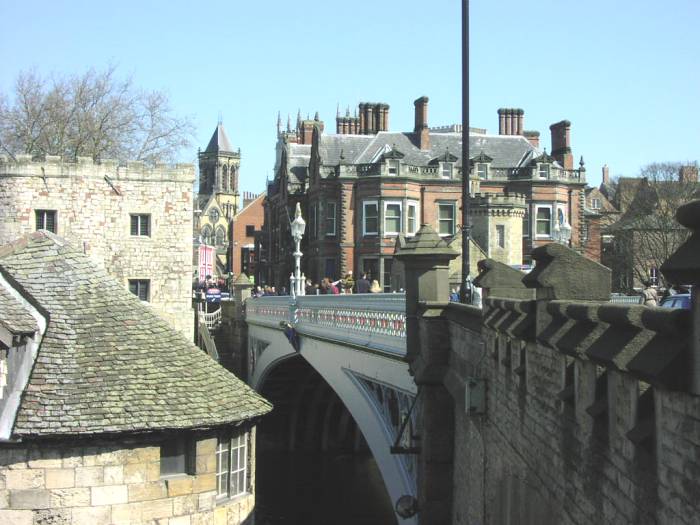
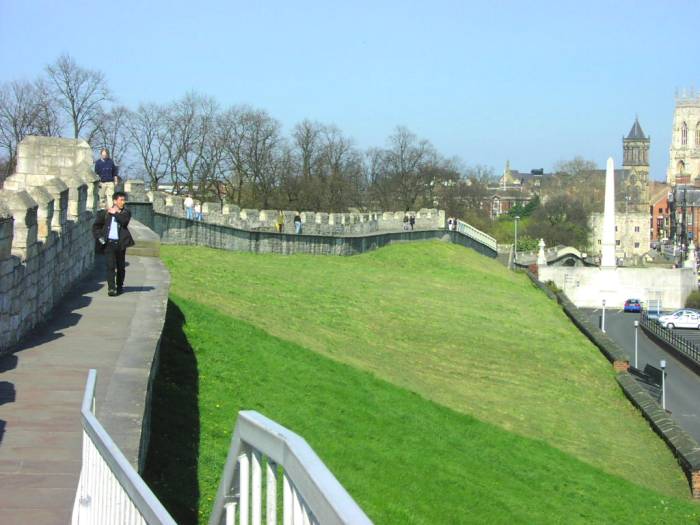
A walk around York’s city walls will take you through 1900 years of
history. First built in Roman times, they have been added to and rebuilt
over time – so that different parts date from different centuries. As
such, they tell the important and fascinating history of York. And as King
George VI once said, "The history of York is the history of England."
York’s city walls are among the longest and best-preserved walls in
England. They are visited by over one million people from all over the
world every year. Originally built as a defensive structure, the focus is
now on conservation. The idea of preserving the walls as a valuable historical monument came to
the fore in the 19th century. At the time, the Corporation of York wanted to
demolish them.
In 1800 the corporation resolved to apply for an Act of Parliament to improve
the city "particularly by the taking down of the walls and
bars". The corporation told Parliament, "The towers, turrets,
walls... are mostly of great antiquity and by reason thereof are are becoming
ruinous... and cannot be repaired, maintained, kept up and preserved in good
order, but at a great annual charge and expense and more than the said mayor and
commonality are able to sustain and pay."
Despite the opposition of King George III, and a campaign from those
determined to protect the walls, the corporation managed to destroy three
walled-fortifications, four gates and some small sections of wall at St Leonard’s
Place and Skeldergate.
Those interested in preserving the walls formed the York Footpath
Association. This group set about raising money and restoring sections of wall.
The first section to be restored was between Micklegate Bar and North Street
Postern in 1831. The corporation, although it allowed this work to be done, was
still far from happy and resolved that, even if the walls were repaired, it
could not agree to maintain them. Even as all this restoration work was going
on, the corporation was in the process of demolishing Layerthorpe Postern.
In 1838, William Etty, a noted local artist and painter of erotic art, and
leading light of the York Footpath Association – argued that the restoration
of the walls should be completed so that they could be used as a tourist
attraction!
The last attempt to demolish a significant section of wall came in 1855, when
the Board of Health Committee proposed to remove "the whole or such part of
the city walls between Walmgate Bar and Red Tower as may be considered requisite
to improve that locality".
It was argued the walls had "no particular historic interest about them
and had been little noticed until the proposed improvement had been
projected". The walls, said the committee, were seen as promoting
ill-health as they obstructed the free circulation of air. Luckily, the
proposal was rejected. And since then the story has been one of progressive
restoration.
Main page