|
The tradition of the Croatian Cyrillic Script goes back to the 12th
century and lasted continuously until the 18th century, with sporadic uses
even in the 20th century. Of course, there are incomparably more Croatian
Glagolitic monuments than Cyrillic, not to speak about tremendous Croatian
literature in the Latin Script since the 15th century. However, it is
the fact that the Croatian Cyrillic represents an important cultural
heritage. This Script was in use among the Croats in Dalmatia (especially in
the Split and Makarska hinterland), in the Dubrovnik region and in
Bosnia-Herzegovina. It is interesting that some of the Croatian Catholics,
who visited the Vatican in the 17th and 18th century, left their signatures
written in the Croatian Cyrillic, which they call expressly the Croatian
script.
Thus, the Croatian Cyrillic includes the following three major regions:
- Bosnia and Herzegovina, (especially widespread among Bosnian
Franciscans),
- the Poljica
Principality (near Split) and Makarska hinterland, as well as
islands of the middle Dalmatia (e.g. Brac),
- the region of Dubrovnik,
including Konavle.
The name of `Bosancica' (or `bosanica') is of a relatively
recent provenance - it has been created by a Croat Ciro
Truhelka in 1889, at that time a very young, 24 years old scientist. Its
rather misleading name suggests that it has been related exclusively to the
territory of Bosnia, which is not true, since it was used in Herzegovina,
Dalmatia and on some Croatian islands as well. It is interesting that
Croatian Cyrillic, i.e. `Bosancica', can be seen in Croatian texts written
in Istria, see below. The name of `western Cyrillic', which also appears in
the literature, is even more imprecise (`western' with respect to what?). It
seems to be appropriate to call this version of the Cyrillic script by the
national name of those who used it most and who left the greatest number of
written documents, as in the case of other national versions (Bulgarian
Cyrillic, Macedonian, Montenegrin, Serbian, Ukrainian, Byelorussian,
Russian). There are also important plaeographic resons, see [Benedikta
Zelic-Bucan]. Thus the notions of Croatian Cyrillic and "Bosancica"
are equivalent.
The name of the Croatian Cyrillic (or Bosancica) had the following
genesis:
- Marko Marulich
(1450-1525): harvatsko pismo (Croatian script),
- Paltasic of Split (16th century): harvatsko pismo,
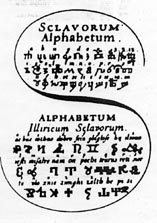 Richard
Daniel (in his book "Daniels Copy-Book: or a Compendium of the
most usual hands..., London 1664"): Alphabetum Illiricum Sclavorum
(Illirucum = Croatian, for example Vat.Illir. documents of the Vatican
library all refer exclusively to Croatian documents), thus Croatian
alphabet, see p.50 of Daniels' book. On the same page you can see Alphabetum
croaticum for the Glagolitic of the 17th century (see Branko
Franolic: "Croatian Glagolitic printed texts recorded in the
British Library General Catalogue," Croatian information centre,
London, 1994 ISBN 953-6058-04-9) Richard
Daniel (in his book "Daniels Copy-Book: or a Compendium of the
most usual hands..., London 1664"): Alphabetum Illiricum Sclavorum
(Illirucum = Croatian, for example Vat.Illir. documents of the Vatican
library all refer exclusively to Croatian documents), thus Croatian
alphabet, see p.50 of Daniels' book. On the same page you can see Alphabetum
croaticum for the Glagolitic of the 17th century (see Branko
Franolic: "Croatian Glagolitic printed texts recorded in the
British Library General Catalogue," Croatian information centre,
London, 1994 ISBN 953-6058-04-9)
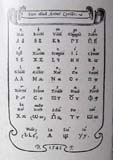 Still
earlier, in 1545 in Rome, an Italian encyclopaedist Giovanni
Batista Palatino presented the Glagolitic (see [the
photo]) and Cyrillic Script (see on the right) in the second edition
of his book Libro Nouvo (Libro nel qual s'insegna a scrivere ogni
sorte lettera, antica et moderna...), among 29 scripts that he
designed for printing. He claims the Glagolitic (which he calls Buchuizza
- bukvica) to be created by St. Jerome, and to be "different from
all other existing Scripts". The Cyrillic is ascribed to St. Cyril.
Palatino also provided a page with tombstone inscription of the Bosnian
Queen Katarina (15th century; burried in Aracoeli, Rome), written in
Croatian Cyrillic, in Latin script (Croatian language) and in Latin
Script (Latin language). The last sentence is SPOMINAK NJE PISMOM
POSTAVLJEN (Monumentum ipsius scriptis positum - Monument written in her
script): Still
earlier, in 1545 in Rome, an Italian encyclopaedist Giovanni
Batista Palatino presented the Glagolitic (see [the
photo]) and Cyrillic Script (see on the right) in the second edition
of his book Libro Nouvo (Libro nel qual s'insegna a scrivere ogni
sorte lettera, antica et moderna...), among 29 scripts that he
designed for printing. He claims the Glagolitic (which he calls Buchuizza
- bukvica) to be created by St. Jerome, and to be "different from
all other existing Scripts". The Cyrillic is ascribed to St. Cyril.
Palatino also provided a page with tombstone inscription of the Bosnian
Queen Katarina (15th century; burried in Aracoeli, Rome), written in
Croatian Cyrillic, in Latin script (Croatian language) and in Latin
Script (Latin language). The last sentence is SPOMINAK NJE PISMOM
POSTAVLJEN (Monumentum ipsius scriptis positum - Monument written in her
script):
- A short note about Croatian Glagolitic and Cyrillic can be found in Viaggio
in Dalmazia by Alberto Fortis, Venice 1774. The book is also
known to have brought the famous poem of Asanaginica
to European public.
- Bosnian Franciscans (all of them are the Croats): Bosanska chirilica,
bosanska azbukvica,
- Ivan Kukuljevich Sakcinski (outstanding Croatian intellectual, 19th
century): Croato - Bosnian Cyrillic (hrvatsko - bosanska cirilica),
- Chiro Truhelka, a Croatian scientist: Bosancica, 1889,
- Vatroslav Jagic
(19th century, Tomislav Raukar (mid 20th century, Zagreb): Western
Cyrillic (western with respect to what??). Jagic also used the name of
"Bosnian - Dalmatian Cyrillic."
- Josip Vrana (in the sixties of the 20th century): hrvatska chirilica
(Croatian Cyrillic),
- Benedikta Zelic-Bucan (leading expert for the Croatian Cyrillic -
Bosancica): since the seventies insisting on the name of the Croatian
Cyrillic (she wrote an important booklet entitled "Bosancica in
Middle Dalmatia" (in 1960, of course, in the Croatian language),
- An important and highly readable book treating the three-script
history of Croatian Middle Ages (including Croatian Cyrillic) is [Hercigonja],
written by outstanding specialist in 1994. It should be consulted by
anybody wishing to study in more detail extremely complex history of
writing among the Croats.
Some of the oldest and most important Croatian
Cyrillic monuments are as follows (here we follow [Benedikta
Zelic-Bucan] and [Hercigonja]):
- the tablet of Humac (Herzegovina), comprising also several
Glagolitic letters (early 11th century according to Hercigonja; 10/11th
century according to Vinko Grubisic),
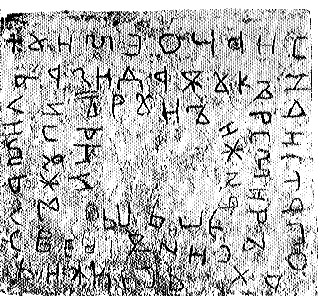
- the Croatian
Cyrillic inscription of the Povlja lintel (1184) from the
Benedictine monastery in the village of Povlja on the island of Brac
near Split;
- the Povlja
parchment Roll from Povlje on the island of Brac (1184, copy from
1250), extensive Croatian Cyrillic text having 53 lines, mentioning 250
old Croatian names,
- the charter document of the Bosnian ban (governor) Kulin
(1198),
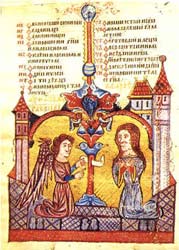
- The Evangel of Prince Miroslav of Zahumlje (dating from the end
of the 12th century), created by Croatian Benedictins, most probably in
the city of Ston on the Peljesac peninsula. It has been noticed already
in the middle of the twentieth century that miniatures of this
evangelistary do not belong to the Byzantine style, but to the Roman
(western) style (Ivan Ostojic in his voluminous three-volume
"History of Benedictins in Croatia").

The language analysis performed by Benedikta Zelic-Bucan,
based on the previous investigations of a Croatian palaeographer Josip
Vrana, shows that it has been written in the Croatian recension of the
Church Slavonic language. This important monument is held in Belgrade (Narodni
muzej), except of one page which is in St. Petersburg.
- the Blagaj inscription from the Bosnian city of Blagaj (second
half of the 12th century),
- the Trebinje inscription of the zupan Grdo from Trebinje in
Herzegovina (second half of the 12th century). "Zupan"
(country prefect). This very old title is in use in Croatia even today.
- the Croatian Chronicle (12th-14th centuries); the famous
Croatian humanist Marko
Marulic translated it from Croatian Cyrillic into Latin in 1510. The
chronicle was written by Archbishop Grgur
of Bar (pop Dukljanin).
- Kocerin
tablet from 1404 (carved in stone in Kocerin near Siroki Brijeg),
with about 300 Croatian cyrillic letters, the text starts with
invocation of Holy Trinity:
Va ime Oca i Sina i svetoga Duha, Amin, se lezi Viganj Milosevic...,
and the concluding message is indicative:
I molju vas ne nastupite na me, ja sam bil kako vi jeste, vi cete
biti kakov sam ja ("And I ask you not to step on me, I was
like you, and you will be like me")
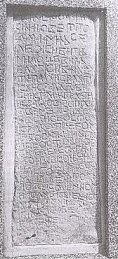
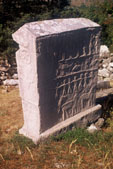
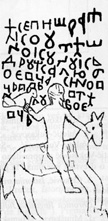
- the cyrillic inscription on the stecak
in Brotnice in Konavle
south of Dubrovnik
probably from 15th century, see [Kapetanic,
Vekaric, Stanovnistvo Konavala 1, p. 24]:
There exists a significant number of Croatian Cyrillic codices,
chronicles, healers' pharmaceopoeias, registers of births, testaments,
personal correspondence etc. Especially important is the Poljice
Statute of the small Prinicpality in the neighbourhood of Split (1440).
Here is a Croatian Cyrillic testament of R. Vladisic written in the
famous fortress of Klis near Split in 1436 (transcription from 1448).
Numerous manuscripts show the parallel use of the Croatian Glagolitic and
Cyrillic Scripts (and also the Latin Script), thus proving that they were
not opposed to each other among the Croats. One of the oldest such examples
originates from Istria (St. Peter in the Wood, 12th century), where in one
single word - Amen - all three Scripts are used! The coexistence and
parallel use of these three Scripts - Croatian Glagolitic, Cyrillic and
Latin - is a unique phenomenon in the history of European culture.
According to Croatian researcher Josip Hamm, members
of the Bosnian Church
(Krstyans) particularly appreciated the Glagolitic Script. Namely, all the
important Bosnian Church books,
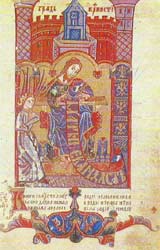
- Nikoljsko evandjelje (Gospel), Croatian parchment Cyrillic
book, copied in around 1400 from older Glagolitic original by Krstyanin
Hval (the name was given according to a Serbian monastery Nikolj where
the manuscript was found, the book is now held in the Chester Beatty
Library, Dublin),
- Sreckovicevo evandjelje (Gospel),
- the Manuscript of Krstyanin Hval, 1404 (copied from older
Glagolitic original; held in University Library in Bologna since 18th
century),
- the Manuscript of Krstyanin Radosav, 15th century (which
contains three Glagolitic notes), held in the Library of De Propaganda
Fide in Rome, etc.
are based on Croatian Glagolitic Church books. For more information about
Bosnian Krstyans see [Leon
Petrovic].
The first printed Croatian Cyrillic book was The
Book of Hours (or the Dubrovnik breviary, or Oficje) published in Venice in
1512, prepared by Franjo Ratkovic from Dubrovnik.
One copy is held in Paris in Bibliothèque Nationale. There is also another
copy in the Codrington Library at All Souls College, Oxford (q.14.9); it was
probably part of the founding bequest of Christopher Codrington in 1710. It
is, admittedly, slightly less complete than the Paris copy, lacking 19
leaves. Many thanks to prof. Ralph Cleminson (University of Portsmouth, UK)
for information about the Oxford copy.
Many of the Croatian Cyrillic inscriptions are carved on tombstone
monuments, called stechak.
According to the Austrian palaeographer Thorvi Eckhardt, the graphics of
the Bosancica (Croatian Cyrillic) shows the greatest independence and
individuality among all the national Cyrillic Scripts - Bulgarian,
Macedonian, Montenegrin, Serbian, Ukrainian, Byelorussian, Russian (see her
monograph Die slawischen Alphabete, Studium Generale VIII, 1967, p.
467).
She was also the first scholar to indicate the political loading in
discussions about the Bosanica. In recent decades Serbian authors have
openly monopolized Croatian Cyrillic as an exclusively Serbian Script. For
more information see [Benedikta
Zelic-Bucan].
A detailed palaeographic analysis of numerous epigraphic monuments found
in Croatia and Bosnia-Herzegovina, related to inscriptions written in the
Croatian Cyrillic, is contained in a monograph of Vinko Grubisic: "Grafija
hrvatske lapidarne cirilice", KHR, München-Barcelona, 1978. Some
of the characteristics of Croatian Cyrillic are:
-
the existence of unusually many ligatures on epigraphic Croatian
Cyrillic monuments, obviously under the influence of Glagolitic script;
In the aforementioned Grubisic's book (p. 108) you will
find a table of 50 interesting Cyrillic ligatures (click on left and
rigth): ab (2), av (2), ai (2), al, amin', am, ao, ap, ar, al, vi, gi,
gr, ez, iv, iy, in, ime, ish, jni, mc, ne, oe, oni (3) ni (3) pis, pl,
pr, pa, rime, tv, tg, ti, til, ca ce, et, ma vi, am, ti mi. This is
a unique characteristic of Croatian Cyrillic;
- absence of tildes, contrary to Cyrillic scripts of other nations
(Bulgarian, Macedonian, Serbian, Ukrainian, Russian);
- among all Cyrillic scripts only Croatian Cyrillic has the numerical
value for CH (i.e. for chrv) equal to 1000, the same as in the
Glagolitic script (see Grubisic's monograph, p. 116).
There exist many types of the Croatian Cyrillic - both carved in stone
and handwritten:
We know of 18 Croatian Cyrillic texts (documents, prayers, letters) that
are a part of the famous Bercic
collection, held in the Russian National Library in St. Petersburg.
These texts contain among others also interesting correspondence between
Muslim officials in Bosnia and Croats. One of the prayers written in
Croatian cyrillic ends with "Amen" written twice: first in the
Glagolitic and then in Croatian Cyrillic.
See a stone
fragment (1640) from Modrus in Lika,
inscribed with letters in Cyrillic and Latin script.
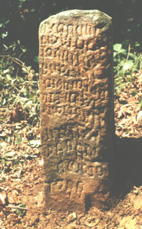
Here is an interesting monument from central Bosnia with inscription for
which it is difficult to decide is it Croatian glagolitic, cyrillic, or
something else:
We illustrate some of numerous very interesting monuments of Croatian
Cyrillic from the Makarska area, see [fra
Karlo Jurisic].
It is interesting that in the franciscan convent in Makarska a baptismal
parish register is preserved from 1664, written in Croatian Cyrillic, see [fra
Karlo Jurisic, pp. 152-153]:
In the same monograph one can find an extremely interesting example of
official correspondence with Turkish officials in Herzegovina written in
Croatian Cyrillic in 1498, dealing with the destiny of franciscans in
Zaostrog, see [fra
Karlo Jurisic, pp. 200-201].
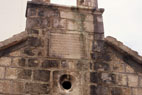
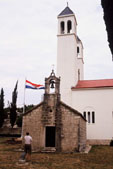
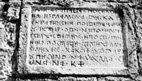
In the town of Zagvozd behind the beuatiful mountain of Biokovo one can
see a lovely Catholic church of all Saints with Croatian Cyrillic
inscription from 1644:
Here is a fascinating example of Three Script character of Croatian Middle
Ages (that is, parallel usage of Glagolitic, Cyrillic and Latin scripts).
You can see a part of the main text written in Croatian Cyrillic, and at the
end, near the cross, AMEN written in Latin, Cyrillic, and Glagolitic (deeply
moving text written by Bare Pifrovic in 1636, in which he thanks God for
having learned these three scripts):

by Darko Zubrinic, Zagreb (1995)
|






