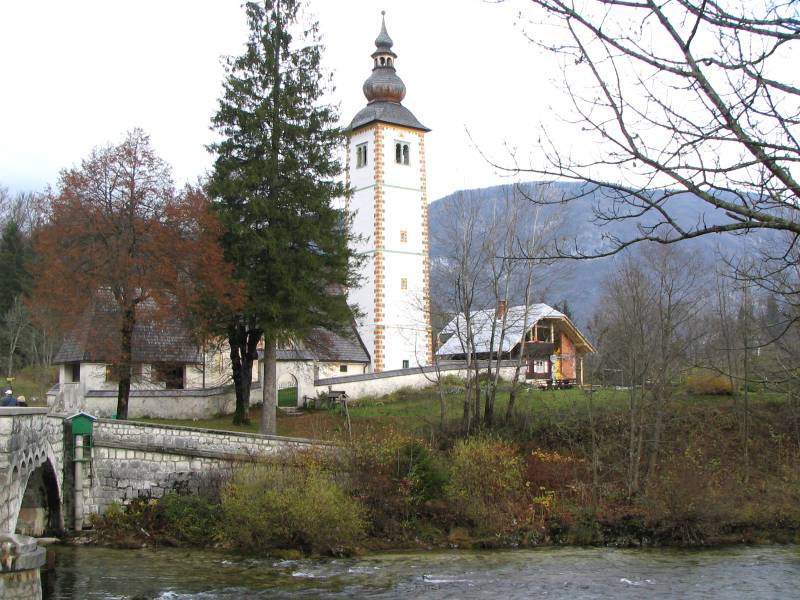
 The church is dedicated to St. John the Baptist, a patron
saint to whom old churches beside lakes or on the banks of rivers were
often dedicated. It is built on a west-east orientation and is
surrounded by an old cemetery wall with two entrances. On an oil
painting by Franz Kurz von Goldenstein (1807—1878), there are still a
number of graves and the shingle roof on the wall, which is still
preserved today. It is not known why he painted a late Gothic window on
the northern facade of the nave. The church is dedicated to St. John the Baptist, a patron
saint to whom old churches beside lakes or on the banks of rivers were
often dedicated. It is built on a west-east orientation and is
surrounded by an old cemetery wall with two entrances. On an oil
painting by Franz Kurz von Goldenstein (1807—1878), there are still a
number of graves and the shingle roof on the wall, which is still
preserved today. It is not known why he painted a late Gothic window on
the northern facade of the nave.
The church nave — probably still a Romanic one — was once about 1.5 m lower than the present one. It had a straight wooden ceiling and its ground plan had the same measurements as it has today: it was 8.30 metres long, 5.20 metres wide, and on the eastern side it probably had — on the evidence of other similar architecture — a semi-circular Romanesque apse. |
|


 |
|
| The present Gothic presbytery with its three windows was built around 1440. It was higher than the former nave with the straight ceiling and has a square ground plan; the eastern side forms three sides of a regular octagon, it has a rib vault and rests on geometrical consoles. In the middle of the vault there is one single boss. The rectangular window on the north wall was cut around 1668 and two identical ones were also cut on the west side of the nave beside the entrance. Around the same period a window was also made in the north wall of the nave, but this was bricked up in 1956, when a lateral altar was placed in front of it. | |
|
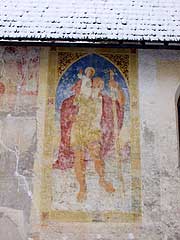
The other bosses are decorated with rosettes of varying sizes, with stylized vine leaves, a stylized lily, a windmill and oak leaves. The ribbed arches and the carved ornamentation are the work of Master HR, who worked in the Upper Carniola area and among other works also built the presbyteries of the parish church in Skofja Loka and of the succursal church in Spodnja Besnica near Kranj. Because of the increased height, the nave became more spacious and airy and demanded more light. Thus a late Gothic window was cut into the south wall of the nave, and in the process some of the Gothic frescos of the Ascension were destroyed and the rest probably painted over for the first time. |
|

|
|
 The nave received its present form around the year
1520, when it was vaulted over with a stellar vault. The bosses are
round and almost all of them were decorated by a stone mason. In the main
transverse rib two bosses are decorated with figures: one with the head
of St. John the Baptist, the other with the Baptism of Christ, with
ducks swimming on the river.
The nave received its present form around the year
1520, when it was vaulted over with a stellar vault. The bosses are
round and almost all of them were decorated by a stone mason. In the main
transverse rib two bosses are decorated with figures: one with the head
of St. John the Baptist, the other with the Baptism of Christ, with
ducks swimming on the river.
| Bohinj page |