|
|
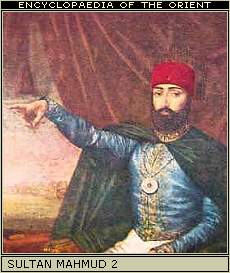
 Mahmud 2's reign is remembered for the
loss of Greece and Egypt,
and for finally ending the Janissaries,
which by then had become an elite group unwilling to reform their military.Mahmud's reform program was mainly
designed by Grand vizier
Bayraktar Mustafa Pasha of Bulgaria who was the one who had put him in
power, and who only got to act as his vizier for half a year, before being
killed. With Bayrakdar dead, the reform program lost its main propagator,
and would not be resumed until the middle of the 1820's.Among Mahmud's reforms were to
introduce the cabinet system of government, ordering a census and a land
survey and establishing a postal service. Moreover, he introduced compulsory
primary education, opened a medical school and allowed students to study in
European countries. Also during his time, European dress was introduced in Constantinople.
Mahmud 2's reign is remembered for the
loss of Greece and Egypt,
and for finally ending the Janissaries,
which by then had become an elite group unwilling to reform their military.Mahmud's reform program was mainly
designed by Grand vizier
Bayraktar Mustafa Pasha of Bulgaria who was the one who had put him in
power, and who only got to act as his vizier for half a year, before being
killed. With Bayrakdar dead, the reform program lost its main propagator,
and would not be resumed until the middle of the 1820's.Among Mahmud's reforms were to
introduce the cabinet system of government, ordering a census and a land
survey and establishing a postal service. Moreover, he introduced compulsory
primary education, opened a medical school and allowed students to study in
European countries. Also during his time, European dress was introduced in Constantinople.
BIOGRAPHY
1785 July 20: Born in Constantinople.
1808: Grand vizier Bayraktar Mustafa Pasha of Bulgaria puts Mustafa
on the sultan throne, after deposing Mustafa 4.
— End of year: The Janissaries revolt, and kill Bayraktar
Mustafa Pasha.
1812 May 28: Treaty of Bucharest ends the 6 year long war with
Russia, where Mahmud has to cede the province of Bessarabia.
1821: Rebellion in the Pelopponese, Greece, aiming at Greek
independence.
1824: Mahmud 2 asks for military aid from the viceroy of Egypt, Muhammad
Ali, promising him that he would get control over Syria
in return.
1826 June 14-15: The Janissary corps find out that Sultan
Mahmud 2 is forming new European-style armies, and revolts. Mahmud 2
declares war on them, and it ends with cannons shooting at the Janissary
barracks in Constantinople and the provincial capitals, killing most of the
troops. Many of the survivors were executed, others were banished. This
ended the period of the Janissaries.
1827 October 20: United British, French and Russian fleets
destroy the Ottoman-Egyptian at the Battle of Navarino.
1828- 29: War between the Ottoman Empire and Russia, which the
Ottomans lose.
1829: Greece declares its independence.
1830: Mahmud 2 accepts the loss of Greece, recognizing it as an
independent country.
1831: After that Mahmud 2 refuses to grant Muhammad Ali control over
Syria as promised, he declares war on the Ottoman sultan and invades Syria,
captures Damascus and Aleppo.
— Mahmud abolishes the system of military fiefs granted to cavalrymen, and
establishes a new army which reports directly to him, and which is led by
German instructors.
1832: The army of Muhammad Ali defeats the Ottoman army at Konya,
and start marching on Constantinople.
1833 July: A Russian fleet arrives at Constantinople, in order
to aid the sultan in the defense against the forces of Muhammad Ali. Russia
and the Ottoman Empire sign a treaty of mutual defense.
1839: Mahmud renews the war against Muhammad Ali.
— June 24: The Ottoman army is finally defeated by the
Egyptian at Nizip (now near the border of Syria and Turkey).
— July 1: Dies in Constantinople from tuberculosis.