|
|
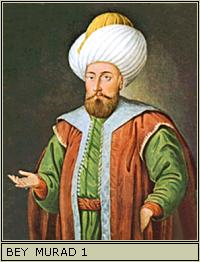
 During his reign the empire saw
expansions in both Anatolia and the Balkans. Equally important was the
efforts put down in building a state system. During his reign, the systems
of a military judge (kaziasker), commander-in-chief (beylerbeyi)
and chief minister (vizier)
were developed. All these positions were given to persons outside the bey
family.During Murad's reign, also the
devsirme
system was started to be developed, together with the Janissary
corps.
During his reign the empire saw
expansions in both Anatolia and the Balkans. Equally important was the
efforts put down in building a state system. During his reign, the systems
of a military judge (kaziasker), commander-in-chief (beylerbeyi)
and chief minister (vizier)
were developed. All these positions were given to persons outside the bey
family.During Murad's reign, also the
devsirme
system was started to be developed, together with the Janissary
corps.
BIOGRAPHY
Around 1326: Born as son of bey Orhan.
1360: Following the death of bey Orhan, Murad succeeds as new bey of
the Ottoman Empire.
1361: Conquers Edirne, which is soon turned into the effective
capital of the empire, and more importantly, the staging point for the
Ottoman expansion into Europe.
1366: Loses Gallipoli to a Christian crusade sent to rescue the
Byzantines.
1367: Murad's forces reconquers Gallipoli.
1371: A coalition of south Serbian princes are crushed near the
Maritsa river. The Macedonian towns of Dráma, Kavála and Sérrai comes
under Ottoman control.
— Another important victory comes at Samakow against a Bulgarian-Serbian
coalition. Following these events, princes of north Serbia, Bulgaria as well
as the Byzantine emperor becomes vassals under Murad.
1385: Conquers Sofia (today's capital of Bulgaria).
1386: Conquers Nis (in today's southern Yugoslavia).
— A Turkmen coalition led by the Karaman is defeated at Konya.
1388: The Ottomans are stopped at Plocnik by Serbians and Bosnians.
1389: Murad and his son Bayezid has the Serbians and Bosnians
defeated at the famous Battle of Kosovo. During the fights, Murad is killed
by a Serbian noble who pretended that he defected to the Ottomans. Bayezid
followed his father as bey.