|
|
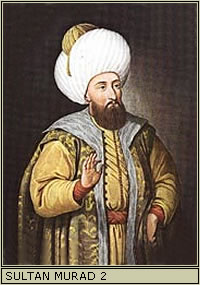
 During his reign many local rulers
inside the empire had much autonomy. This was particularly the case in the
Balkans, and in the case of the principality of Karaman on Anatolia. Apart
from that, Ottoman suzerainty was gained over many Turkmen rulers in central
and western Anatolia.But Murad was careful about not
provoking a conflict with the Timurid Shah Rokh – the memory of the battle
of Ankara in 1402 which almost had destroyed the empire was still strong.During his years in office, the
position of grand vizier
came to be dominated by the Çandarli family, and the Janissaries
grew stronger in the administration.
During his reign many local rulers
inside the empire had much autonomy. This was particularly the case in the
Balkans, and in the case of the principality of Karaman on Anatolia. Apart
from that, Ottoman suzerainty was gained over many Turkmen rulers in central
and western Anatolia.But Murad was careful about not
provoking a conflict with the Timurid Shah Rokh – the memory of the battle
of Ankara in 1402 which almost had destroyed the empire was still strong.During his years in office, the
position of grand vizier
came to be dominated by the Çandarli family, and the Janissaries
grew stronger in the administration.
BIOGRAPHY
1404 June: Born in Amasya
(today's central Turkey).
1421: Becomes sultan, but just as the case had been for the preceding
sultan, there are several claimants to the throne. Some had support from the
Byzantine emperor, and others from Turkmen principalities in Anatolia.
1425: Murad defeats the last usurper, and secures Ottoman control
over western Anatolia, as well as forcing Byzantium to pay tribute.
1430: Conquers Salonika (today's Greece) from Venetian control.
1441: The Ottomans lose Nis (today's Yugoslavia) and Sofia (today's
capital of Bulgaria) to an alliance of European forces.
1444: The Ottomans are defeated at Jalowaz.
— June 12: With signing a peace treaty at Edirne,
Murad resigns to his 12 year old son, Mehmed
2.
— November: After that Christian forces break the truce
signed at Edirne, Murad leads his forces to a victory against the Christians
at Varna (today's Romania).
1446 May: As he sees that foreign pressure is too strong, and
is called back by the Janissaries, Murad reassumes power of the empire from
his son. Mehmed is sent to Manisa (near Izmir)
for continued training, but Mehmed still considered himself to be the legal
sultan.
1448 October 17: Murad defeats the Hungarians at the second
Battle of Kosovo.
1451 February 3: Dies in Edirne.