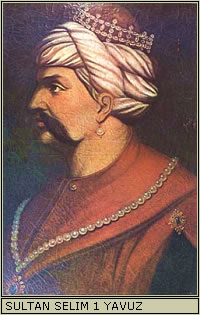
His byname was Yavuz, which can be translated from Turkish into English with "the Grim".
(1470- 1520)
Ottoman sultan from 1512 till 1520
By the beginning of his reign, he faced enemies both inside the empire as well as on all eastern and southern borders. For about a year before his accession, a conflict had been going on between Selim and his brother Ahmed. Their father was eventually forced to resign in favour of Selim, to ward off a more destructive conflict where both sons were allying with external rulers. As soon as Selim had become sultan, he chose to eliminate all potential claimants to the sultanate but his favourite son Süleyman 1, in order to prevent a new conflict as he had been through.
BIOGRAPHY
1460: Born in Amasya.
1511: A conflict over the succession to the sultanate breaks out between Selim and his brother Ahmad. Selim seeks assistance from the khan of Crimea. The situation soon gets heated, and sultan Bayezid 2 has to interfere.
1512: Sultan Bayezid steps down from the throne, and leaves this in Selim's hands to stop a continued escalation of the internal strife.
1514 August 23: At the battle of Chaldiran, Selim strikes a heavy defeat on the Safavid sultan Isma'il 1, and effectively secures the eastern borders. Selim then incorporated Kurdish and Turkmen principalities in Anatolia. These advances provoked the Mamlukes, who considered some of these areas as belonging to their interest zone. The result is a war between the two empires.
1516 August 24: At battles north of Aleppo, the Ottomans defeat attacking Mamluke troops.
1517 January 22: The final blow to the Mamluke empire comes with a battle near Cairo. Egypt, Syria and Hijaz fall into Ottoman hands.
1520 September 22: Dies in Çorlu.