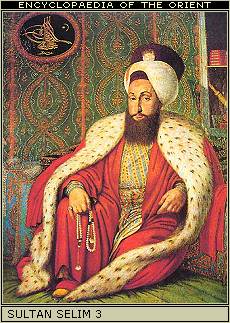
Selim's fame is mainly connected to his modernization programme, which sought to end the administrative, social and economic chaos in the empire. Before his accession to power, the Janissary soldiers had become more and more unruly and the ayan nobles, who owned land had become more and more like independent rulers often acting without regard to the interests of the sultan.
(1761 - 1808)
Ottoman sultan from 1789 until 1807
The program was greatly inspired by Western ideas, and included reforms of regional administration, taxation and the ayan ownership of land. Selim introduced rules of the administration of the ayan, where they now could be removed if they did not perform according to the rules of the sultan.
BIOGRAPHY
1761 December 24: Born in Constantinople, Ottoman Empire, as son of sultan Mustafa 3.
1789 April 7: Becomes sultan of the Ottoman Empire, succeeding his uncle Abdülhamid 1. At this time, the Ottoman Empire has been to war with Austria and Russia for 2 years.
1791: Signs a treaty with Austria at Sistova, ends this part of the war. The Ottoman Empire has to give up strategically important lands and fortresses that controlled the lower Danube.
1792: The war with Russia ends with the treaty signed at Jassy, costing them the control of certain river mouths on the Black Sea.
1793: Selim opens up an Ottoman embassy in London.
1795: Embassies are opened up in Berlin, Vienna and Paris.
1798: Napoleon invades Egypt, forcing Selim to seek alliance with Great Britain and Russia.
1801: France withdraws from Egypt, resulting in improved relations between the two countries.
1805: The Janissaries mutiny in Edirne, and are joined by ayan nobles in their opposition to the sultan.
1806: In alliance with France, the Ottoman Empire declares war on its former friends Great Britain and Russia.
1807: A new revolt, this time from the yamak army forces Selim to stop many of his reform programs.
— May 29: Selim is deposed and placed in royal prison by the new sultan, his nephew Mustafa 4.
1808 July: Grand vizier Bayraktar Mustafa Pasha of Bulgaria marches with an army of 40,000 men on Constantinople, with the aim to restore Selim to power.
— July 29: Before Bayraktar Mustafa reaches Constantinople, Selim is strangled by the command of the sultan. Bayraktar Mustafa deposes Mustafa 4, replacing him with Mahmud 2.